
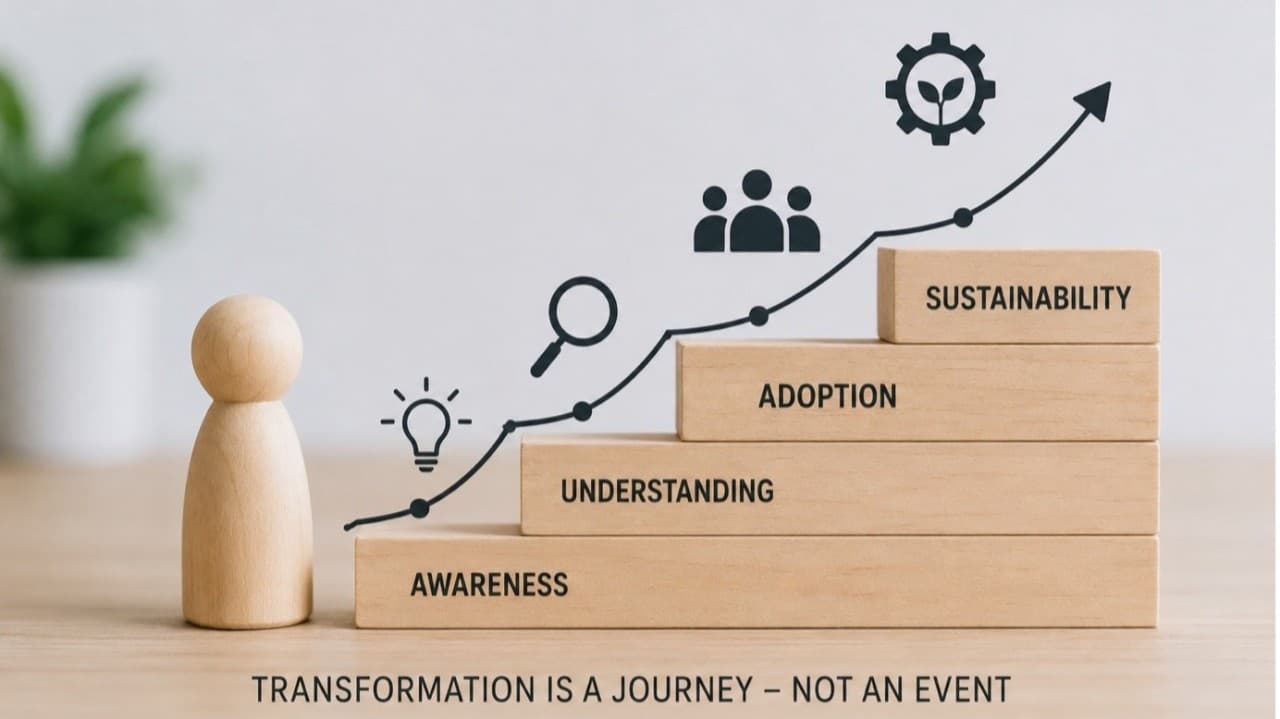
Why successful transformation requires more than milestones, metrics and governance
There is a well-known saying that the only constant is change, and when I look back over my career, that has certainly been true. Almost every role I have held has involved some form of transformation, whether that meant testing new products and processes, redesigning an operating model, leading business risk and control activity across multiple regions, deploying a brand-new internal software platform, migrating work across locations, introducing new governance frameworks, or using data and modelling to improve the way decisions were made.
My involvement in change dates back as far as 2003, when I was carrying out business-event testing alongside my operational role. Since then, the programmes have become larger, more complex and more global, but one thing has remained consistent: transformation is never only about the process, the system, the operating model or the data. It is about the people who must make the change work.
When organisations embark on a transformation programme, progress is usually measured through dashboards. We track milestones, budgets, risks, productivity, implementation dates and delivery against plan. Governance forums are established, status reports are produced and key performance indicators are monitored. All of this is important, of course, but it does not tell us the whole story.
A dashboard can tell us whether a project is on schedule. It cannot always tell us whether people understand why the change is happening, whether they trust the direction being taken, whether they have the capacity to deliver it, or whether they genuinely believe it will make things better. That is where transformation can begin to unravel.
Implementation is not the same as adoption
One of the biggest lessons I have learned is that completing a project milestone does not necessarily mean the change has landed. A system can go live. A new operating model can be announced. Training can be completed. A revised process can be signed off. Yet teams may still be working around the new solution, relying on old habits, or struggling to understand how the change fits into their day-to-day responsibilities.
I have seen how easy it is for an organisation to declare a transformation complete while the people expected to operate within it are still somewhere between the old world and the new one. On paper, everything may look green. In reality, teams may be creating manual workarounds, responsibilities may remain unclear, and managers may still be rewarding behaviours linked to the previous model.
That is not unusual. People need time to understand, test, question and adapt. True transformation happens when the new way of working becomes the normal way of working, not simply when a box is ticked on a project plan.
People need to understand the “why”
Leaders often spend a great deal of time explaining what is changing. There may be a new structure, a new system, revised controls, different responsibilities or a new set of performance measures. What people are not always given is a clear explanation of why the change is necessary, what problem it is trying to solve, and what it will mean for them personally.
That connection matters. When I have led teams through change, I have found that people are much more likely to engage when they understand the purpose behind it and can see how their role contributes to the bigger picture. They do not just need a presentation, a timeline or a set of instructions. They need context. They need the opportunity to ask questions. They need to know that their concerns have been heard.
Without that clarity, people fill in the gaps themselves, and uncertainty can quickly turn into resistance. Not necessarily loud resistance, but the quieter kind: reduced engagement, delayed decisions, lower energy and people doing just enough to get through.
How do we bring teams on the journey?
This is the part of transformation that I believe is often underestimated. We spend a lot of time designing the destination, but not always enough time thinking about how we will bring people with us.
People experience change differently. Some will immediately see the opportunity. Others will worry about what they might lose. Some will want every detail from the beginning, while others will need time to process what the change means. Good leadership recognises that there is no single response to change and no single communication that will work for everyone.
For me, leading teams through transformation means being clear about where we are going and honest about what we do not yet know. It means listening properly, not simply waiting for people to finish speaking. It means creating space for challenge without automatically labelling it as resistance. It means building capability, recognising progress and remaining visible throughout the journey, not only at the launch.
People notice whether leaders continue to show up once the initial excitement has passed. They notice whether feedback results in action. They notice whether the behaviours being encouraged are also being demonstrated by those at the top.
The people closest to the process often see the risks first
My career has spanned operations, client management, business risk, controls, testing, transformation and data. Across all of those areas, I have repeatedly seen that the people closest to the process often know where the problems are long before those problems appear in a report.
They know where customers are experiencing delays. They know which controls create value and which create duplication. They know where a process depends too heavily on individual knowledge. They know where a new system does not quite reflect operational reality.
When I redesigned an operating model or built out new governance and risk frameworks, the strongest outcomes came from combining strategic direction with the practical knowledge of the people doing the work. That does not mean every concern changes the course of a programme, but it does mean concerns should be treated as useful operational intelligence rather than an inconvenience.
Sometimes what looks like resistance is actually experience speaking.
Data matters, but context matters too
Data is central to transformation. It helps us understand the current state, identify inefficiencies, track progress and measure whether the expected benefits are being delivered. My own work has increasingly involved testing, data analysis and modelling, and I strongly believe in the value of using data to support better decisions.
However, data without context can also create false confidence. A training completion rate of 100% does not mean people feel confident using the new system. A reduction in processing time may look positive until we discover that an important control is being bypassed. A cost-saving target may have been achieved while workload, customer dissatisfaction or operational risk has increased elsewhere.
A dashboard shows us what has been measured. Conversations help us understand what those measurements actually mean.
The question should not only be, “What is the data telling us?” It should also be, “What might the data be missing?”
Transformation fatigue is real
Many organisations are not managing one transformation. They are managing several at the same time. Employees may be asked to implement a new system, respond to regulatory change, reduce costs, improve customer outcomes, restructure teams and continue delivering business as usual, all at once.
When everything is a priority, people eventually lose sight of what matters most. Transformation fatigue does not always show itself through open resistance. More often, it appears as declining energy, missed deadlines, transactional meetings, delayed decisions and people becoming less willing to contribute beyond what is required.
Having led teams through significant change, I have learned that capacity cannot simply be assumed. Effective transformation leadership means making choices about what teams should stop doing, not just adding more work and expecting people to absorb it. It also means recognising when teams need greater clarity, more support or the opportunity to pause and reset.
Leadership behaviour sets the tone
People pay attention to what leaders do, not only to what they say. When leaders talk about openness but react defensively to challenge, people stop speaking honestly. When they talk about collaboration but continue to reward individual delivery at the expense of collective outcomes, silos become stronger. When they say the transformation is a priority but continue to focus on the old measures, employees receive mixed messages.
Change is rarely a straight line. There will be setbacks, lessons and moments when the original plan needs to be adjusted. Strong leadership is not about pretending that everything is going perfectly. It is about staying accountable, being willing to adapt and keeping people connected to the purpose.
People do not expect leaders to have every answer. They do expect honesty, consistency and a willingness to listen.
Looking beyond the dashboard
Dashboards will always have an important role in transformation. We need to know whether the programme is on track, whether risks are being managed and whether benefits are being delivered. But the dashboard should be the start of the conversation, not the end of it.
We also need to ask whether our people understand the purpose of the transformation, whether they have the skills and capacity to deliver it, whether our measures reflect genuine outcomes rather than completed activity, and whether leadership behaviour is reinforcing the change we want to see.
After more than two decades of leading and contributing to change, I remain convinced that transformation is not something an organisation simply implements. It is a journey that people must be willing and able to take together.
The operating model matters. The technology matters. The controls, testing, data and governance all matter. But ultimately, sustainable transformation depends on whether leaders can bring their people with them.
The dashboard may tell us whether the programme is progressing.
Our people will tell us whether the transformation is truly working.
What do you believe leaders can do differently to help their teams navigate change?
If your organisation is navigating operational change, redesigning the way teams work, or struggling to turn a transformation plan into something people genuinely understand and adopt, I would be very happy to connect. Through Lilley Professional Pathways, I support organisations and leaders with operational transformation, risk and governance, process improvement, data-led decision-making and the human side of change. Please feel free to reach out to start a conversation.